

Nitrogen is one of the most widely used industrial gases, with applications ranging from food packaging and electronics manufacturing to pharmaceutical production and chemical processing. Traditionally, nitrogen has been supplied in compressed gas cylinders or as liquid nitrogen delivered by tanker. On-site nitrogen generation offers an alternative that gives businesses direct control over their nitrogen supply without dependence on external logistics. For those considering a nitrogen generator presscon.com, understanding how the technology works is the logical first step. This article explains the principles behind nitrogen generation and what makes it a practical solution across a wide range of industrial applications.
What is a Nitrogen Generator?
A nitrogen generator is a system that extracts nitrogen gas from compressed air and delivers it at a controlled purity level for use in industrial processes. Atmospheric air consists of approximately 78 percent nitrogen and 21 percent oxygen, with the remainder made up of argon and trace gases. A nitrogen generator separates the nitrogen from the other components of air, producing a continuous supply of nitrogen gas at the point of use.
The key advantage of this approach is self-sufficiency. Rather than ordering, storing and managing gas cylinders or liquid nitrogen deliveries, a business with an on-site nitrogen generator produces exactly the volume of nitrogen it needs, when it needs it, at a consistent purity level suited to its specific application.
The Two Main Technologies: PSA and Membrane
Nitrogen generators operate on one of two main separation technologies: Pressure Swing Adsorption (PSA) or membrane separation. Each has distinct characteristics that make it more or less suitable depending on the application and purity requirements.
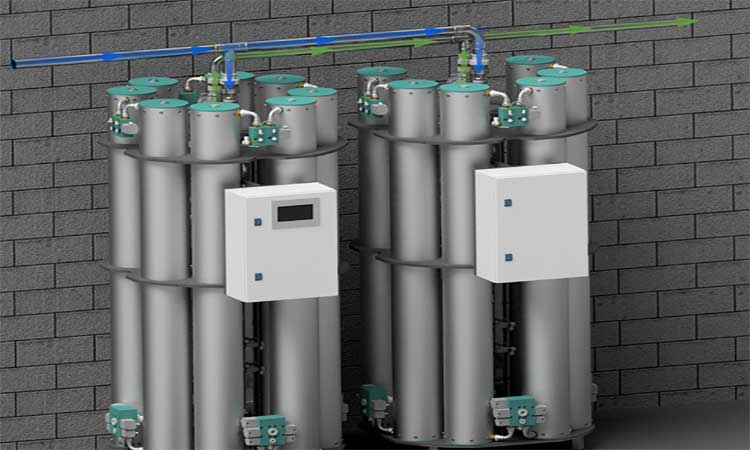
PSA nitrogen generators work by passing compressed air through vessels filled with carbon molecular sieve (CMS) material. The CMS selectively adsorbs oxygen and other gases while allowing nitrogen to pass through. The process alternates between two vessels: while one vessel is adsorbing oxygen, the other is being regenerated by depressurisation. This cycling process delivers a continuous flow of nitrogen at high purity levels, typically between 95 and 99.999 percent, making PSA technology the preferred choice for applications with strict purity requirements.
Membrane nitrogen generators work on a different principle. Compressed air is passed through a bundle of hollow polymer fibres. Oxygen and water vapour permeate through the fibre walls faster than nitrogen, allowing a nitrogen-enriched stream to exit from the end of the membrane module. Membrane generators are compact, have no moving parts and require minimal maintenance, but are generally limited to purity levels of up to around 99.5 percent. They are well suited to applications where moderate purity is sufficient and simplicity of operation is a priority.
How Purity Levels Affect Performance and Application
The purity level of the nitrogen produced by a generator is one of the most critical parameters in the selection process. Different applications require different purity levels, and selecting a generator that delivers the right purity for the intended use is essential for both performance and cost efficiency.
In food packaging, purity levels typically range from 99 to 99.9 percent, sufficient to displace oxygen effectively and extend product shelf life. In electronics manufacturing, where nitrogen is used to prevent oxidation during soldering, purity requirements are significantly higher, often exceeding 99.999 percent. In laser cutting, nitrogen is used as an assist gas to produce clean, oxide-free cut edges, requiring purity levels of 99.9 percent or above depending on the material being processed.
Generating nitrogen at a higher purity than necessary increases energy consumption and reduces flow capacity, so matching purity to application is both a technical and an economic consideration.
Key Industries and Applications
Nitrogen generators are used across a broad range of industries. In the food and beverage sector, nitrogen is used for modified atmosphere packaging, blanketing of storage tanks, purging of pipelines and inerting of bulk storage. In the electronics industry, nitrogen is used in reflow soldering, wave soldering and component storage. In the pharmaceutical and chemical industries, nitrogen provides an inert atmosphere for sensitive processes and prevents oxidation during storage and transfer.
Laser cutting operations across the metalworking and fabrication sectors rely on high-purity nitrogen as a cutting assist gas for stainless steel, aluminium and other non-ferrous metals. Tire inflation with nitrogen is another well-established application, offering more stable pressure over time compared to compressed air.
Advantages of On-site Nitrogen Generation
The shift from supplied gas to on-site generation offers several practical advantages. Supply security is perhaps the most significant: an on-site generator eliminates dependence on delivery schedules, cylinder management and the risk of supply interruptions. Businesses that operate continuously or have critical nitrogen requirements benefit from having a reliable, uninterrupted supply under their direct control.
Cost efficiency improves over time as the capital investment in a generator is offset against the ongoing savings on gas procurement. The break-even point varies depending on nitrogen consumption volumes, but for businesses with consistent and significant nitrogen requirements, on-site generation typically delivers a favourable return on investment within a few years. Safety also improves, as the risks associated with handling and storing high-pressure cylinders or cryogenic liquid nitrogen are eliminated.
Nitrogen Generation as a Reliable and Efficient Solution
A nitrogen generator transforms compressed air into a continuous, controlled supply of nitrogen gas using well-established separation technologies. Whether based on PSA or membrane principles, the core value proposition is the same: on-site production of nitrogen at the required purity, volume and pressure, without dependence on external supply chains. For businesses with consistent nitrogen requirements across food, industrial or technical applications, on-site nitrogen generation offers a reliable, cost-effective and operationally straightforward solution.